
Over the course of my career, I’ve led housekeeping operations, environmental services, and post-construction cleaning for hospitality properties. I’ve built departments, developed operational systems, and led teams through some of the most demanding environments our industry faces. When I was asked to lead housekeeping through the renovation of a hotel with more than 400 rooms, I understood what it took to prepare rooms for guests. What I was about to experience was how every department contributes to that goal and why housekeeping has a perspective that is often missing from the planning process.
Our first major room launch was originally scheduled for November 18. When that deadline was missed, those rooms were rolled into the next scheduled launch on December 23, creating a 66-room launch just two days before Christmas.
By the time December 23 arrived, housekeeping had done everything we were supposed to do. Our staffing was in place, our supervisors were ready, our supplies were staged, and our quality assurance process was built. We weren’t walking into that launch hoping it would work. We walked in expecting it to work.
It didn’t take long to realize we weren’t receiving guest-ready rooms. The rooms looked close to complete, but construction complete and guest ready turned out to be two very different standards. That distinction would become one of the most important lessons of the entire renovation.
As my team and I moved from room to room, every door revealed another issue. Fifteen rooms still needed shelving in the shower and had brass pipes sticking out of the wall. Another couldn’t be completed because tile work wasn’t finished. Every television had to be powered on because several of the outlets hadn’t been wired correctly. Furniture and linen packages were incomplete because of ongoing backorders, forcing us to decide which rooms could temporarily use older inventory just to get them back into service.
Then came the operational questions that nobody had been asking.
Could a housekeeper actually push a fully loaded upright down these hallways without hitting every decorative light fixture that had just been installed?
Would those new hallway sconces survive six months of daily housekeeping traffic?
Could the upright even roll across the new flooring without becoming a safety issue for staff?
Are the mattresses too heavy for staff to lift, repetitively?
How many times would we have to re-enter the same room because another trade still needed access?
None of those questions started on launch day. Launch day was simply the first day anyone could see the answers.
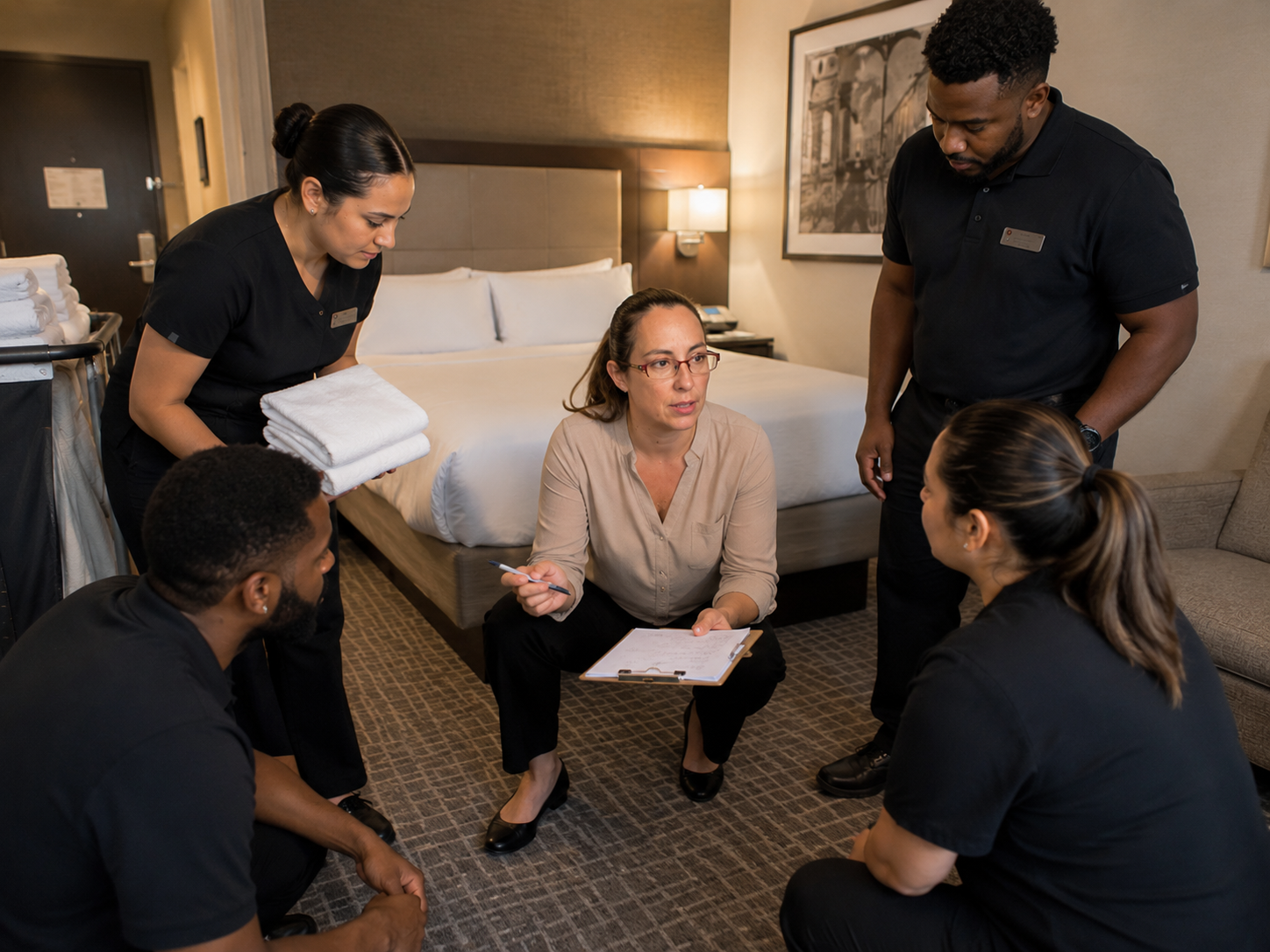
I remember walking into one of the rooms with my leads. We closed the door behind us. For the first time all day, I stopped moving, squatted down, and took a deep breath. Nobody spoke. My leads didn’t need me to explain what I was seeing. They had walked every room with me. They already understood the magnitude of what was unfolding. They weren’t waiting for instructions as much as they were watching to see how we would move forward.
At that moment, it became clear that housekeeping’s responsibility extended far beyond cleaning rooms. We were making operational decisions that affected the guest experience, our staff, and the success of the launch itself. This was about leading a team through a situation that no amount of preparation from housekeeping could have prevented. After a few moments, they watched me take that breath, gather myself, and stand back up. No speech was given, no panic ensued, decisions were simply made. We changed priorities. We adjusted assignments. We identified which rooms could honestly be returned to inventory and which ones couldn’t. Then we went back to work.
Years later, my leads still remember that moment. Not because I sat down, but because they watched me accept the reality of the situation, make decisions, and keep moving forward.
Looking back, that room taught me something I still believe today.
Housekeeping doesn’t just clean the finished product. Housekeeping is the department that reveals whether the finished product actually works in daily operations. We don’t just ask whether the tile is installed. We ask whether it can be maintained, whether furniture fits in the room, and whether a housekeeper can clean around it efficiently every day for the next ten years. We don’t just ask whether the renovation looks beautiful; we ask whether it will function beautifully after thousands of guest stays.
That’s why housekeeping belongs at the planning table, not because we’re another department that needs to be informed, but because we see operational realities that no blueprint or construction schedule can fully reveal.
What I didn’t realize that day was that this launch had exposed only a fraction of what we would discover over the next nine months. Our team would uncover operational issues that changed the way I think about procurement, launch phases, staffing, FF&E planning, and even hotel design itself.
Those lessons are where this series begins.
Leave a Reply